
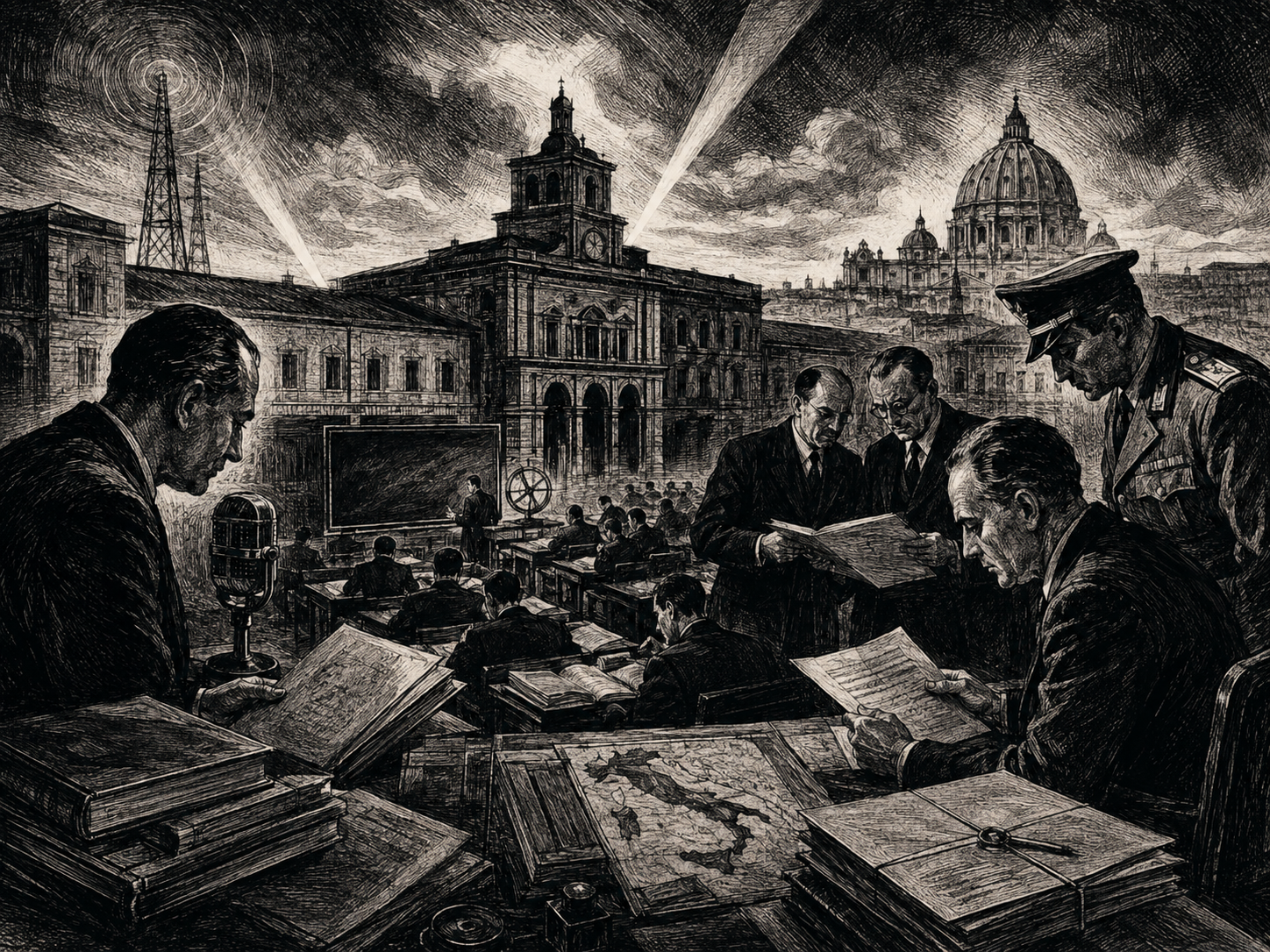
How Italy reached the heights of functional illiteracy.
In the previous article, we reconstructed the role played by the Allied authorities in reorganizing the Italian school system after 1943, focusing in particular on Carleton Wolsey Washburne, the American educator, officer of the Allied Military Government and later director of the United States Information Service in northern Italy.
The documentation that has emerged since then allows us to go considerably further.
We have found no proof that Washburne belonged to the OSS or that the Italian school system was directly administered by American intelligence services. What has emerged, however, is historically more concrete: around the Education Subcommission there existed a network in which education, political investigation, security, propaganda, psychological warfare and international information repeatedly came into contact.
The new archival material makes some of those contacts tangible.
Intelligence Within the Educational Circuit
The Education Subcommission is usually described as the Allied body responsible for reopening schools, removing the Fascist imprint from education and assisting in the reconstruction of the Italian educational system.
The archival record reveals a more complex structure.
Research based on material held by the US National Archives identifies within the educational apparatus personnel whose duties extended well beyond pedagogy.
Among those employed within or closely connected to the Education Subcommission were Second Lieutenant H.T. Coker and George Hauser of the Counter Intelligence Corps, both associated with intelligence functions. Joseph Vella had previously carried out political investigation duties.
This does not turn the Education Subcommission into an intelligence agency.
It does show that education in an occupied country was not regarded as a field entirely separate from political security.
Knowing who taught, what political positions they had held under Fascism, which organizations they belonged to and what influence they exercised over students could simultaneously become an educational and a security matter.
Schools and universities were institutions through which the next generation would be formed. For an occupying power, their political composition could hardly be treated as irrelevant.
The Case of the Catholic University
The affair surrounding the Catholic University of the Sacred Heart in Milan makes this overlap particularly visible.
In 1945, the Allies examined the conduct of professors and administrators at the university during the Fascist period. The most delicate case concerned Father Agostino Gemelli, founder and rector of the institution.
The reasons for the investigation were concrete.
For years, Gemelli had maintained institutional relations with the Fascist regime. During the second half of the 1930s and the early years of the war, he had delivered speeches and published statements in which Fascism and Catholicism were presented as possible allies against Communism.
In some of these interventions, he identified common ground in concepts such as hierarchy, order, discipline and sacrifice.
After the fall of Fascism, those statements were difficult to explain merely as the formal deference expected from the rector of an important university toward the government of the day.
Even the internal commission examining Gemelli acknowledged that, particularly after the Lateran settlement of 1929, he had publicly adopted positions of considerable proximity to the Fascist state.
A more controversial issue concerned his relationship with antisemitism and Fascist racial policies.
The historiography is not uniform on this point. Scholars have identified compromising statements and attitudes connected with traditional Catholic antisemitism, while other evidence shows Gemelli assisting persecuted Jewish scholars and distancing himself from certain forms of biological racism.
The conduct of the Catholic University during the German occupation further complicated the picture. Antifascists and individuals connected with the Resistance found space within the university environment, while people associated with the institution helped protect some of those being persecuted.
Gemelli therefore did not fit neatly into the category of a straightforward collaborator with the regime.
That ambiguity made his case politically explosive.
A Commission Considered Too Lenient
The first commission appointed to examine Gemelli’s position essentially concluded in favor of his remaining in office.
The Allies considered the outcome too lenient.
According to documentation concerning the Education Subcommission, Arthur Vesselo informed Washburne that Gemelli’s stature appeared to have influenced the proceedings as a whole. The fear was that, in order to avoid suspending the rector, the commission had softened its judgments regarding other members of the university as well.
At that point, the Regional Security Office entered the process.
The office examined the material and issued a negative assessment of the way the purge had been conducted.
In August 1945, the documentation, together with the Security Office’s findings, was forwarded to the headquarters of the Education Subcommission so that Washburne could examine it personally.
The archival reference is precise: NARA, Record Group 331, Education, box 1507, file 10000/144/376, “Epuration of Catholic University.”
The route taken by the dossier deserves attention.
A university matter was examined by a security body; its assessment entered the educational decision-making process; the head of the Education Subcommission received the material and personally intervened.
Here the relationship between security and education was no longer merely one of institutional proximity.
It became a documented flow of information.
Washburne Intervenes Personally
Washburne did not limit himself to reviewing the file in Rome.
On 31 August 1945, he travelled personally to Milan and confronted the purge commission, obtaining a stricter reconsideration of the proceedings.
This episode broadens the image of the American educator considerably.
His role concerned more than teaching methods, curricula and textbooks. It could extend to decisions about the individuals who would continue to hold prestigious positions within Italian universities.
And intervention in universities meant intervention in the future ruling class.
An educational system is not formed only by the contents of textbooks. It is also formed by those who are permitted to teach, those who direct universities, those who train professionals and those whose ideas retain academic legitimacy.
The purge therefore had consequences extending beyond punishment for collaboration with Fascism.
It also affected the personnel authorized to shape postwar Italy.
Relations With the Holy See
Gemelli’s position inevitably required another level of negotiation.
The Catholic University was not an ordinary institution, and its founder maintained relationships reaching directly into the upper levels of the Church.
Washburne personally discussed the matter with representatives of the Holy See.
On 12 June 1945 he met Cardinal Giuseppe Pizzardo, Cardinal Ernesto Ruffini and Giovanni Battista Montini, then a central figure in the Vatican Secretariat of State and later Pope Paul VI.
Documentation concerning these meetings appears within the same archival group relating to the purge of the Catholic University.
This further broadens Washburne’s institutional profile.
He dealt with military authorities, security organizations, university commissions and senior Vatican officials.
Italian education was therefore being treated at a political level far beyond the organization of classrooms.
The Textbooks and the Psychological Warfare Branch
New archival evidence provides one of the clearest material links yet discovered between the educational apparatus and the psychological warfare structure.
In a memorandum dated 4 February 1944, preserved in the Allied Control Commission files under 10000/105/709, Washburne described the work being carried out on new elementary school textbooks.
The Education Subcommission was preparing revised editions of existing state textbooks by removing or rewriting passages considered Fascist propaganda.
The revision process was supervised by the Allied educational authorities.
To print the new books, however, Washburne needed paper.
His memorandum requested approximately 75 tons of newsprint.
The significant detail is where the available paper was located.
Around 168 tons were being held in Naples by the Psychological Warfare Branch, PWB.
Washburne formally requested that 75 tons be transferred from PWB control to the Education Subcommission for the production of textbooks intended for occupied Italy beyond Sicily and Calabria.
This document does not prove that the Psychological Warfare Branch wrote the textbooks or determined the educational curriculum.
It proves something narrower and more concrete.
Material controlled by the psychological warfare apparatus was requested by Washburne in order to print the new schoolbooks being prepared under Allied supervision.
The relationship was therefore not merely theoretical or organizational.
There was operational cooperation.
How the New Textbooks Were Produced
The same documentary material clarifies how the revision process worked.
A commission composed of teachers and school administrators considered politically reliable and non-Fascist was established in Palermo.
Existing textbooks were examined.
Passages judged unacceptable were identified and rewritten.
The process took place under the supervision of the Education Division of the Allied Military Government and later the Education Subcommission.
The significance lies less in the removal of Fascist propaganda, which was an obvious objective after the collapse of the regime, than in the broader principle established by the procedure.
The occupying authorities were directly supervising the transition from one educational narrative to another.
The old ideological framework was being dismantled.
The new framework was being actively constructed.
Morale, Citizenship and the Long-Term Program
Another memorandum written by Washburne on 17 November 1944, identified in the Allied Control Commission records as 10000/144/107, sheds even more light on the purpose attributed to education.
Washburne distinguished between two levels of intervention.
The first was immediate and practical: reopen schools, remove children from the streets, reduce disorder and prevent educational collapse during the occupation.
The second was explicitly long-term.
The aim was to help the Italian government create an educational system capable of producing “good citizenship”, a proper attitude toward the wider world and greater economic efficiency.
This goes well beyond reopening classrooms.
Washburne linked the longer educational program to the morale of the population, which he considered part of the responsibility of military government.
He argued that eliminating Fascism required more than removing symbols and officials. Its causes had to be addressed, democratic habits introduced and the population prepared for peaceful participation in international affairs.
Education was therefore conceived as an instrument of political transformation.
The terminology matters.
The school was not simply expected to transmit knowledge.
It was expected to help produce a particular form of citizen.
The Instruments of Long-Term Influence
Washburne’s November 1944 memorandum also identified practical instruments for this longer project.
Foreign educational works were to be selected and translated into Italian under Allied supervision; British and American books and periodicals were to be distributed to universities, libraries and scientific organizations; scholarships were to enable Italians to study in the United States, Britain and elsewhere in Europe; foreign specialists were to be brought into Italy after the war.
Seen separately, each measure can be presented as educational exchange.
Seen together, they reveal something broader.
Already in 1944, before the end of the war, an infrastructure was being imagined through which educational models, literature, specialists and students would circulate between Italy and the Anglo-American world.
This was an early architecture of what would later be called cultural diplomacy.
Education as a Political Question
The Gemelli affair and the textbook documents point toward the same underlying principle.
In 1945, reforming an Italian school or university also meant deciding which individuals would continue to exercise influence, which institutions would be considered politically reliable, which narratives would remain legitimate and what type of citizen should emerge from the new order.
In a defeated country, educational reconstruction could not avoid becoming political reconstruction.
This does not mean that every educational decision was secretly dictated by intelligence agencies.
It means that education had become one of the strategic fields in which the future political culture of Italy was being shaped.
From Occupation to Re-Education
This logic was not limited to Italy.
In July 1945, Office of War Information director Elmer Davis wrote to President Truman about Germany, identifying the re-education of the German population as one of the central problems of the postwar period.
Davis noted that newspapers, radio broadcasts and newsreels produced by the OWI-Army apparatus already represented the practical beginning of that process.
The language is significant.
Information and re-education could belong to the same institutional logic.
We have not found an identical directive for Italy that would justify applying the German model automatically.
But we can observe what was taking place in Italy during the same period: revision of curricula, supervision of textbooks, political purges, intervention in universities and an explicit concern with the formation of “good citizenship”.
The similarity deserves examination.
It should not be confused with proof of identical policy.
The Office of War Information Did Not Simply Disappear
On 31 August 1945, President Harry Truman signed Executive Order 9608, terminating the Office of War Information.
At first sight, the decision might suggest that the wartime propaganda apparatus was simply dismantled.
The reality was different.
The OWI’s international information functions were transferred to the Department of State together with personnel, archives and resources.
Truman publicly acknowledged that psychological warfare had been regarded by military commanders as an important wartime weapon, while arguing that part of America’s overseas information activity needed to continue in peacetime.
In January 1946, those functions were reorganized within the Office of International Information and Cultural Affairs.
The wartime organization disappeared.
The function survived.
From Propaganda to Foreign Policy
Later State Department documents make the continuity clearer.
During the Second World War, the United States had accumulated extensive experience in propaganda, public opinion analysis and psychological warfare.
After the war, part of this expertise was incorporated into foreign policy.
The logic was straightforward: information specialists had to understand political objectives; communication programs had to support those objectives; officials conducting international information activities required access to the knowledge necessary to construct effective messages.
Communication was therefore treated as an instrument of foreign policy rather than as a decorative cultural activity.
And the OSS?
The Office of Strategic Services, OSS, was dismantled during the same period.
Truman ordered its dissolution on 20 September 1945.
Its accumulated capabilities did not simply disappear.
The Research and Analysis Branch and Presentation Branch were transferred to the Department of State, while other OSS functions passed to the War Department.
The distinction between OWI and OSS remains essential.
The OWI primarily conducted overt information and propaganda operations.
The OSS performed intelligence work and clandestine operations as well.
They were not the same organization.
Both, however, generated personnel, analytical methods, archives and operational expertise that the United States considered valuable in the emerging postwar order.
The war ended.
The institutional memory did not.
Washburne Moves to USIS
Carleton Washburne’s subsequent career must be placed inside this broader transformation.
After his work within the Allied Military Government and the Education Subcommission, he became director of the United States Information Service for northern Italy.
This occurred precisely while Washington was converting wartime international information structures into a permanent apparatus connected with American foreign policy.
The chronological coincidence does not prove a clandestine assignment.
It does make Washburne’s transfer more significant than an ordinary career change.
The official who had participated in the educational reconstruction of occupied Italy moved into the organization through which the United States intended to continue communicating directly with Italian society.
And his educational activity did not end.
The 1947 Special Report on Education Activities
A further archival reference strengthens this continuity.
On 12 November 1947, while Washburne was serving as director of USIS for northern Italy, he participated in the preparation of a document entitled “Special Report on Education Activities.”
The report is preserved in the Rockefeller Foundation archives, RG 2, 1947, Series 751, Box 390, Folder 2632.
Its subjects included an educational course for Italian professors in Switzerland, Italian groups associated with the New Education Fellowship, and activities involving Boy Scouts and Girl Guides.
This matters because Washburne was no longer serving within the military educational administration.
He was now a senior official of an American information service.
Yet educational networks, professors and youth organizations remained part of his professional activity.
His own recollections already suggested that he continued to be consulted on education after moving to USIS.
The 1947 report provides an additional documentary trace of that continuity.
A Broader Network Than It First Appeared
The institutional map can therefore be drawn with greater precision.
The Education Subcommission intervened in schools and universities; personnel connected with intelligence and political investigation operated within its environment; the Regional Security Office produced assessments used in university purge proceedings; Washburne intervened directly in those proceedings and negotiated with the Vatican; the Office of War Information conducted overt information and propaganda; the Psychological Warfare Branch worked explicitly on morale and public perception; the OSS gathered and analyzed intelligence through separate structures; after the war, significant capabilities developed during the conflict were transferred into civilian institutions.
We can now add a direct operational bridge.
The PWB held the paper requested for the printing of Allied-supervised Italian schoolbooks.
We can also add Washburne’s own formulation linking the long-term educational program to population morale and the formation of “good citizenship.”
And we can follow him into 1947, when education remained part of his activity while he served inside USIS.
None of this proves the existence of a secret central command controlling every element.
The documentation reveals something less theatrical and arguably more important.
A modern conception of power in which administration, education, security, information and influence belonged to overlapping fields.
Continuity Beyond the War
Perhaps the most significant feature of this history is what survived beyond 1945.
The end of military hostilities did not produce a clean separation between wartime information structures and postwar cultural activity.
Instead, there was a process of conversion.
Propaganda became international information; analysis of morale became systematic attention to public opinion; wartime communication expertise entered foreign policy; military administration gradually gave way to cultural diplomacy.
The vocabulary changed.
The institutions changed.
The political objectives changed.
But the accumulated knowledge about influencing populations did not vanish when the armies stopped fighting.
And the Italian School System?
The limits imposed by the evidence remain important.
We cannot claim that the Republican Italian school system was designed by American intelligence.
We cannot demonstrate that USIS dictated Italian curricula.
We cannot call Washburne an OSS agent on the basis of the documents currently available.
We also cannot demonstrate that the Psychological Warfare Branch wrote Italian textbooks.
What we can now say is more precise.
The reconstruction of Italian education took place within an environment in which education, political purging, security, intelligence, propaganda, psychological warfare and international information repeatedly interacted.
The Catholic University case provides a documented flow from a Security Office into educational decision-making.
The February 1944 memorandum provides a documented logistical relationship between the Psychological Warfare Branch and the production of revised schoolbooks.
The November 1944 memorandum shows Washburne explicitly connecting long-term education with population morale, democratic transformation and the production of good citizenship.
The 1947 report shows that educational activity continued to accompany him after he entered USIS.
These are not theories.
They are separate archival traces which, when placed next to one another, form an increasingly coherent institutional picture.
Selecting Those Who Would Shape the Future
The significance of these interventions extends beyond individual officials or individual textbooks.
Universities train professors, judges, journalists, public officials, doctors, professionals and political leaders.
Schools shape millions of citizens before they enter adult society.
A military occupation may last several years.
An educational structure can influence generations.
A professor may teach for thirty years.
His students may later hold positions of authority for another forty.
A textbook used by thousands of children can establish categories that survive long after the administrators who approved it have disappeared.
The long-term significance of educational reconstruction therefore lies not merely in changing what Italians thought in 1945.
It lies in influencing the institutions through which future Italians would learn how to interpret politics, authority, history and society.
Governing Perception
The common thread running through the emerging documentation is not necessarily conspiracy.
It is a theory of government.
Schools produce interpretive categories; universities produce elites; the press and radio produce narratives; intelligence gathers information about social reactions; propaganda attempts to influence those reactions; cultural diplomacy allows forms of influence to continue after the end of military occupation.
Seen from this perspective, Washburne’s career becomes easier to understand.
Educator, military officer, supervisor of educational reconstruction, participant in university purges, interlocutor with the Vatican, correspondent with Allied public-relations structures, later director of an international information service and still involved in educational activities.
These roles need not be contradictory.
They can be understood as different functions within a political conception in which reconstructing a country also means intervening in the institutions through which that country interprets itself.
What Still Remains to Be Found
The research has now reached a more precise stage.
We have documented intelligence personnel within the educational environment.
We have identified a case in which a Security Office directly entered a university purge procedure.
We have found a direct logistical link between the Psychological Warfare Branch and the production of Allied-supervised Italian textbooks.
We have Washburne’s own memorandum linking long-term educational reform to morale and good citizenship.
We have reconstructed the transition from wartime information institutions to postwar diplomatic structures.
We have evidence that Washburne continued educational work while serving as director of USIS.
One type of document is still missing.
A directive, memorandum or correspondence explicitly showing whether the educational objectives applied to Italy were coordinated at a higher strategic level with psychological warfare, security or intelligence objectives.
Until such evidence appears, the distinction between institutional interaction and strategic coordination must remain clear.
But the distance between the two has become considerably narrower.
After the War, the Battle Continues
The year 1945 is remembered as the year of liberation.
It was also the year in which structures created to win the war began to be converted into structures suited to governing the peace.
The OWI disappeared, but its overseas information functions passed into the State Department.
The OSS was dissolved, but important analytical capabilities survived elsewhere.
Military propaganda gradually gave way to international information and cultural diplomacy.
Allied administration returned formal authority to Italian institutions while the United States established a lasting presence in information, culture and education.
In the middle of this transformation stood the school.
And above all, the university.
An army may occupy a country for several years.
An educational system acts across generations.
Military control ends when soldiers leave.
Influence over those who will train teachers, officials, professionals and future political elites can endure for much longer.
The Gemelli dossier, the PWB paper memorandum, Washburne’s writings on morale and the later USIS educational reports all force us to look at Italy’s reconstruction through a wider lens.
The question is no longer simply who governed Italy in 1945.
It concerns who participated in shaping the institutions that would teach Italians how to understand the political order in the decades that followed.
Because the most far-sighted form of power does not merely seek to determine who will make tomorrow’s decisions.
It seeks to influence who will teach the next generation which decisions appear possible, legitimate and eventually even thinkable.
Rispondi